
Having created your current state value stream map we move onto the more difficult task of creating an Ideal state map and your future state value stream maps. Your Ideal state value stream map is the ultimate goal of your improvement process and provides you with an objective to work towards, the future state map is your plan for the next two to three months; you define what you would like to improve and plan to achieve it within the timescale.
This article follows on from our step by step guide on creating a value stream map and describes how value stream mapping or VSM can be used to drive improvement within an organization.
We are going to run through;
- Why do we need an Ideal State VSM
- How to create an Ideal state VSM
- Ideal state Value Stream Map Example
- Future state value stream map
- Moving from Current state to Ideal State
You can download a free presentation for creating your VSM which can be used in conjunction with what is written here:
Future State Value Stream Map Presentation PPT
Future State Value Stream Mapping Presentation PDF
Why do we need an Ideal State VSM
Your Ideal state value stream map is exactly what it says; the absolute ideal for your process. It forms a shared vision of what your value stream mapping team is trying to achieve. It should be created by the team with guidance from the facilitator and the senior management, it should be challenging, even to the point of today appearing impossible; but like eating the elephant we will get there one mouthful at a time.
How to create an Ideal state VSM
You ideal state value stream map really needs the guidance of someone who if familiar with the principles of lean manufacturing and how many other companies implement them. Our process must focus on value as defined by the customer, and all other steps should be removed or minimized as much as possible. We must identify how that value flows through our value stream and this may require more detailed process mapping of parts of our value stream. Then we must make sure that the value can flow without delays and obstacles. By this point we should have moved to the point where individual tasks are located closer to each other without huge piles of inventory between them. Then we look to implement pull at the demand of the customer using simple kanban systems.
Ideal state Value Stream Map Example
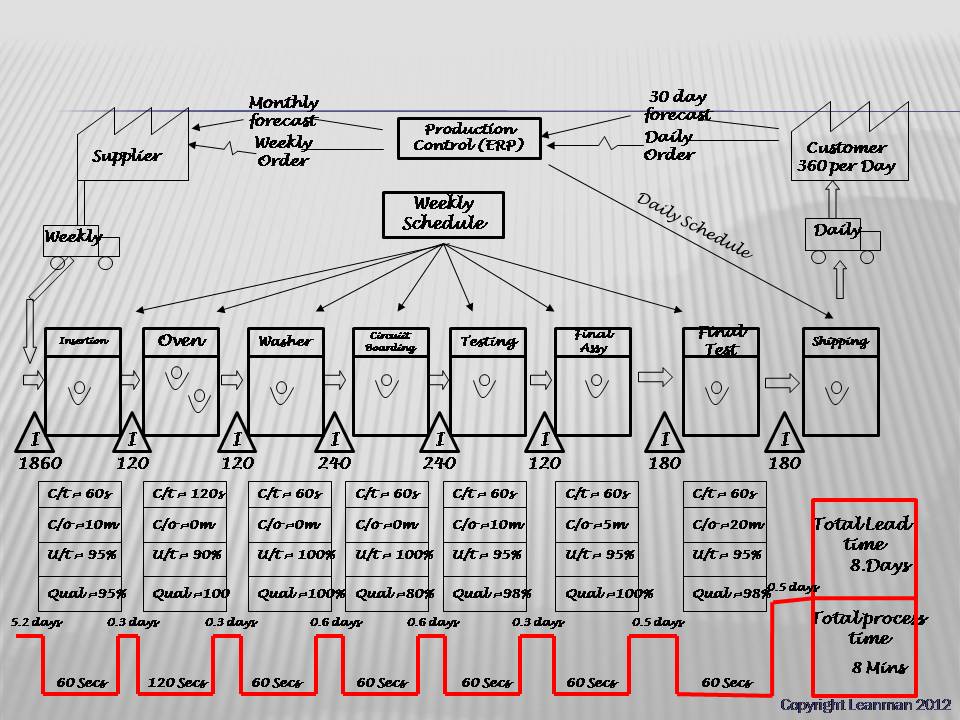
This is our current state value stream map that we created in our step by step guide.
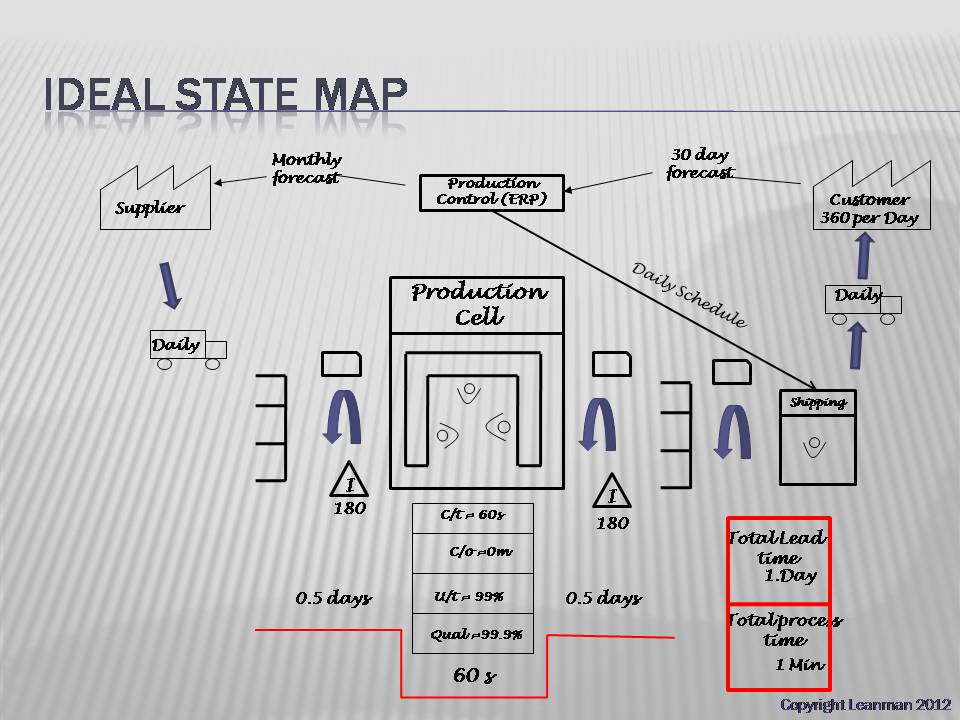
This is my suggestion for an ideal state, a single work cell comprising of all of the various operations, taking supplied product from a “supermarket” using a kanban system; the supplier replenishing daily also through kanban. The cell feeds a another supermarket where the shipping personnel pick the required product for the customer on a daily basis. A very simple system without the need for scheduling every operation and minimizing inventory.
Future state value stream map
Your future state value stream map is in an interim stage between your current state map and the ideal state that is your goal for the whole exercise. You use your current state map to identify the areas of concern that need to be improved over the coming months and you set targets for your change.
These changes typically include;
- Reduce Cycle Time
- Reduce setups / reduce batches
- Improve quality performance
- Change delivery schedules
- Implement kanban
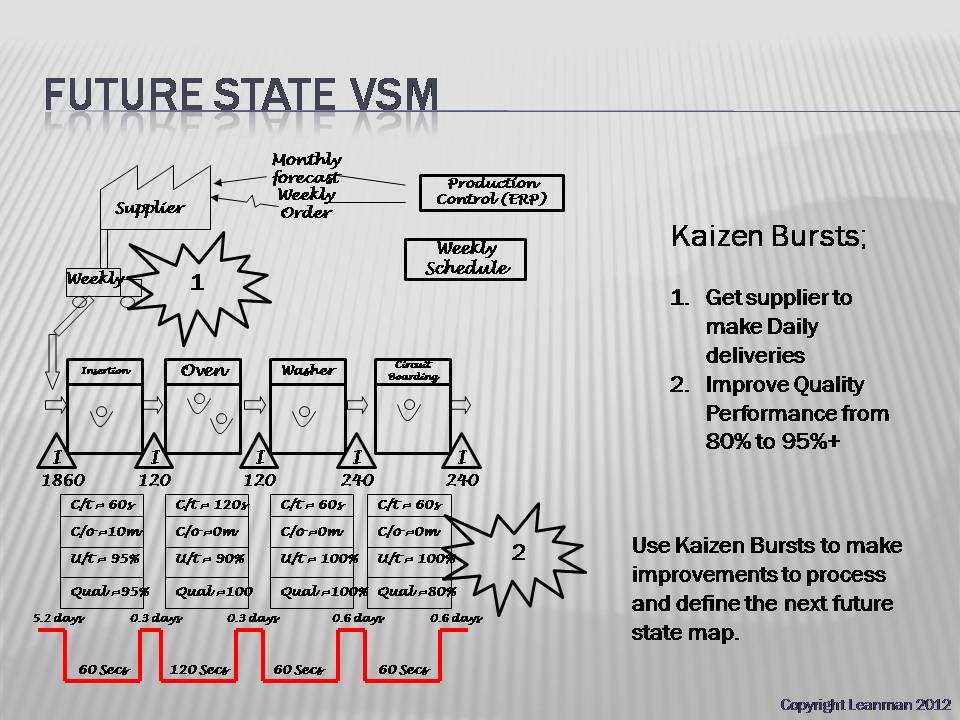
You would annotate these changes on your map using the kaizen burst icon as well as updating the target value that you would want to achieve, for instance reducing change over time from 20 minutes to 10 minutes.
Make as many changes as you can comfortably make within a 2-3 month period and support what you want to achieve with detailed action plans as required to keep things on track.
At the end of your project period your future state map will become your new current state and you can then plan the next series of changes.
Moving from Current state to Ideal State
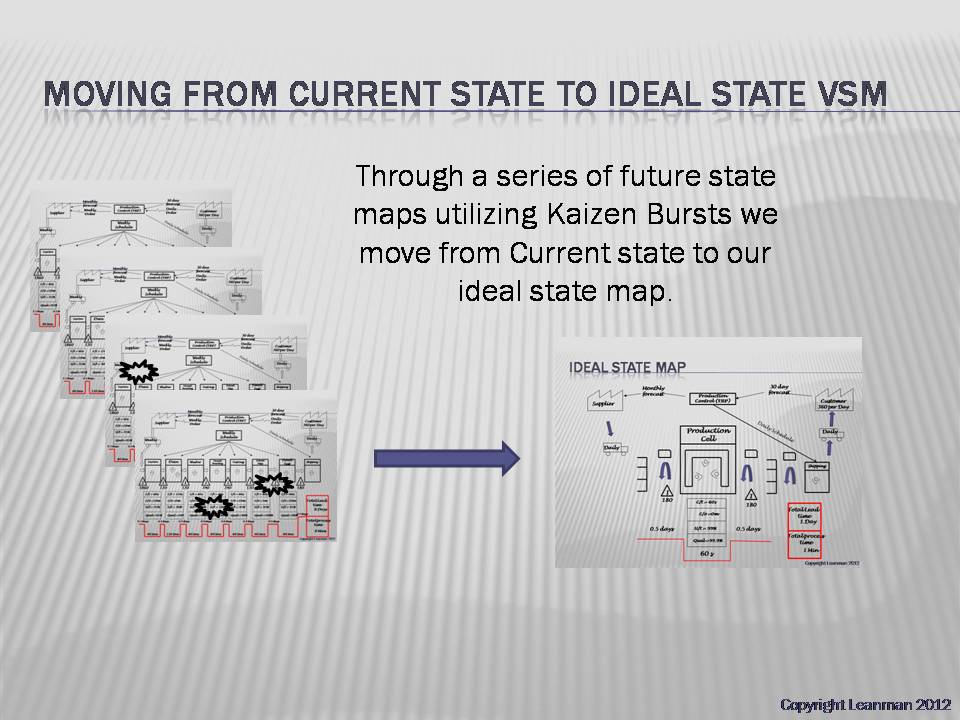
Typically you would need to have several interim future state maps before you managed to reach your ideal state map, you cannot rearrange your shop floor overnight to create work cells before you first tackle issues such as long change overs, poor quality performance and so on. These things take time to implement and for people to settle into new ways of working.
The likely hood is that as you move through each iteration of your map that you will uncover more and more issues that will require solving, issues such as machine reliability, unofficial rework and many other things are typically hidden by the inventory within the system and as you begin to remove that inventory you will uncover these rocks trying to sink your progress. After each project cycle recollect process data to confirm improvements and to highlight these “new” problems.
I hope that this has helped you to better understand how to go from your current state, through various future state maps to reach your ideal state VSM. If you have any comments or questions please leave them below.
4 comments for “Creating your Ideal and Future State Value Stream Map”